






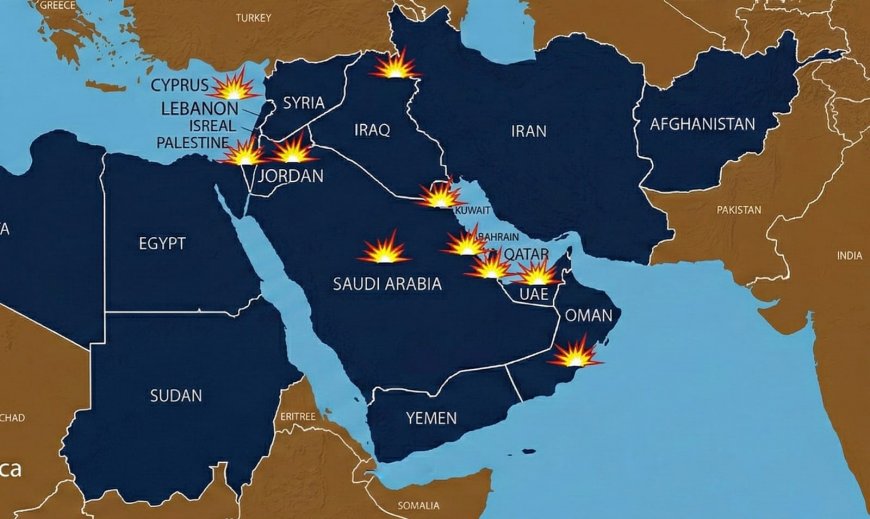
Middle East crisis: The 10 Countries Targeted by Iran in the Ongoing Conflict


In a dramatic escalation of tensions across the Middle East, the Islamic Republic of Iran has launched a series of coordinated missile and drone strikes against multiple countries in the region, following the start of a joint U.S.–Israeli military campaign known as “Operation Epic Fury.”
The retaliatory campaign began after the United States and Israel initiated offensive operations on February 28, 2026. Iranian officials described the strikes as a “measured but firm response” to what they called violations of national sovereignty and regional stability.
Widespread Targets Across the Region
According to regional security sources, Iran’s response has involved ballistic missiles, cruise missiles, and armed unmanned aerial vehicles (UAVs). The strikes reportedly targeted military facilities and logistical hubs in at least ten Middle Eastern nations believed to host U.S. military assets or provide operational support for the joint offensive.
Among the countries reportedly affected are:
• Israel
In Israel, the latest phase of the broader Middle East conflict has seen an unprecedented barrage of Iranian ballistic missiles, with more than 160 projectiles launched in the first 48 hours of the campaign, overwhelming air defenses in several areas. Major population centers including Tel Aviv, Haifa, Beit Shemesh, and parts of West Jerusalem have been under intense strike pressure. Verified impacts include a direct hit on a residential building in Tel Aviv on February 28 and a deadly missile strike in Beit Shemesh on March 1 that devastated a community and sparked widespread emergency response efforts. Israeli health and emergency services report 9 confirmed fatalities and more than 777 injuries, with many more suffering varying levels of trauma as sirens continue to sound and search and rescue operations proceed.
• United Arab Emirates
In the United Arab Emirates, authorities reported the detection of approximately 167 missiles and 541 drones in national airspace during the latest wave of strikes, marking one of the largest aerial security incidents in the country’s history. Key areas affected included Dubai — particularly near the Fairmont Palm Hotel and the Burj Al Arab — as well as Abu Dhabi, where the Al Dhafra Air Base was among the reported targets. Verified impacts included damage to a terminal at Dubai International Airport and fires breaking out in parts of the Palm Jumeirah. Officials confirmed that three foreign nationals — from Pakistan, Nepal, and Bangladesh — were killed, with at least 58 others injured. Emergency services responded swiftly to contain fires and secure affected zones as air defenses remained on high alert.
• Bahrain
In Bahrain, several strategic and civilian-linked sites were impacted amid the latest escalation, including the U.S. Navy’s Fifth Fleet Headquarters in Manama, Bahrain International Airport, and Al-Ma'arid Street. Authorities confirmed that a kamikaze drone struck a building on Al-Ma'arid Street, causing structural damage in a commercial area, while a U.S.-flagged tanker was hit while moored at port. Officials reported two fatalities and six injuries, as emergency crews secured affected zones and naval security operations were heightened around key maritime and military facilities.
• Kuwait
In Kuwait, key infrastructure sites including Kuwait International Airport and Ali Al Salem Air Base were affected during the recent wave of aerial activity. Authorities confirmed that falling drone debris ignited a fire at a major airport terminal, prompting temporary flight disruptions and emergency evacuations. Amid the confusion, U.S. Central Command reported that three U.S. F-15 fighter jets were lost to friendly fire from Kuwaiti air defense systems responding to incoming threats. Officials stated that one civilian was killed and at least 32 others were injured, while investigations continue into the sequence of events during the high-intensity air defense engagement.
• Saudi Arabia
In Saudi Arabia, heightened tensions were felt in the capital as two drones struck the U.S. Embassy compound in Riyadh on March 2, triggering what officials described as a “limited fire” that was quickly contained by emergency teams. Security was also intensified around Prince Sultan Air Base amid broader regional alerts. While no fatalities were confirmed, authorities reported several minor injuries and temporary lockdown measures in surrounding areas as investigations and damage assessments continued.
• Qatar
In Qatar, key strategic assets were targeted amid the escalating regional conflict, including Al Udeid Air Base — the forward headquarters for U.S. Central Command — and energy facilities in Doha. Officials confirmed direct strikes on several military hangars at the air base as well as damage to peripheral energy infrastructure, raising concerns about operational disruptions. Authorities reported at least 16 injuries, while emergency response teams and security forces moved swiftly to secure affected sites and assess the extent of structural damage.
• Iraq
In the Kurdistan Region of Iraq, Iranian linked strikes targeted U.S. military infrastructure and allied logistical hubs amid the broader Middle East conflict, with key locations including the U.S. military base in Erbil and the area around Jurf al Nasr. Reports indicate that attacks struck U.S. affiliated facilities and supply points, contributing to the volatile security situation in northern Iraq as air defenses engaged incoming threats. Local authorities confirmed that 2 people were killed and 3 others wounded in these strikes, underscoring the growing peril faced by coalition personnel and Iraqi civilians in the semi autonomous region caught in the expanding conflict.
• Jordan
In Jordan, defensive operations were activated over the capital after Iranian-linked aerial attacks targeted the Muwaffaq Salti Air Base. Most incoming threats were intercepted over Amman, though stray debris from intercepted missiles and drones caused minor damage in the outskirts of military installations. Authorities reported 5 injuries resulting from falling debris, while air defense units remained on high alert to protect critical infrastructure and nearby civilian areas.
• Oman
In Oman, strategic port facilities came under attack amid the escalating regional conflict, with key locations including Khasab Port and Duqm Port. Verified impacts included a Palau flagged oil tanker struck north of Khasab and a drone strike on infrastructure at Duqm Port, causing fires and operational disruptions. Authorities reported 1 foreign worker killed and 4 others injured, while emergency crews and port security personnel moved quickly to contain damage and secure maritime traffic in the affected areas.
• Cyprus
In Cyprus, heightened security measures were implemented around RAF Akrotiri after Iranian-linked drone activity targeted the British military installation. Two drones were intercepted on March 2 while approaching the base, following an initial attack the previous evening. Authorities confirmed that no fatalities occurred, and defense forces remained on high alert to prevent further incursions and safeguard both personnel and critical infrastructure.
Most of the targeted nations are majority-Muslim countries, many of which maintain defense partnerships or host military infrastructure linked to U.S. operations in the region. Analysts say the strikes appear aimed at disrupting supply chains, command centers, and funding networks associated with the campaign against Iran.
Shift From Shadow War to Direct Confrontation
Security experts note that this marks a significant shift from the long-running “shadow war” between Iran, Israel, and U.S. interests. Previous confrontations often involved proxy militias, cyber operations, or deniable strikes. The current campaign, however, represents direct, state-to-state military engagement.
Regional governments have responded with heightened air defense measures, temporary airspace closures, and emergency security meetings. Several countries confirmed interceptions of incoming missiles and drones, though damage assessments are ongoing.
International Reaction
The escalation has prompted urgent diplomatic activity at the United Nations and among major world powers. Calls for de-escalation have intensified amid fears that continued strikes could trigger a broader regional conflict affecting global energy markets and international shipping lanes.
As of now, casualty figures and the full extent of the damage remain unclear. Military analysts warn that further retaliation from either side could widen the conflict in the coming days.
The situation remains fluid, with regional and international leaders urging restraint to prevent a full-scale war in the Middle East.
What's Your Reaction?